
Bali Stay Tips
Why the Best Bali Escapes Balance Privacy and Connection
One of the quietest challenges in choosing a stay in Bali is finding the right balance between privacy and connection. Most travellers want both, even if they do not describe it that way at first. They want a place that feels sheltered, calm, and personal, but they also want to feel connected to the island itself — its atmosphere, its rhythms, its texture, and the sense that they are not cut off from the very thing they came to experience. The best Bali escapes tend to succeed because they understand that tension. They create retreat without isolation, and access without noise.
This balance is part of what makes Bali so distinctive as a destination. The island is filled with places that offer beauty, but beauty alone is not what creates a memorable stay. A stay becomes memorable when it lets people feel protected from distraction while still keeping them close to the feeling of Bali itself. For a broad sense of how place, environment, and everyday life connect in Bali, UNESCO’s overview of the Cultural Landscape of Bali Province gives useful background.
Privacy Is About Atmosphere, Not Just Distance
Many travellers assume privacy means being far away from everything. Sometimes that is true, but not always. In Bali, privacy often comes from design and positioning rather than remoteness alone. A stay can feel deeply private even when it is not far from restaurants, beach roads, or village life, provided the property creates a sense of enclosure, calm, and spatial separation once you step inside.
This is why arrival matters so much. A gate, a courtyard, a planted wall, a subtle change in sound, or a gradual movement from public road into sheltered space can all signal that the outside world is receding. Privacy begins not when a property is hidden, but when it establishes a different rhythm from what surrounds it.
Connection Keeps a Stay From Feeling Generic
At the same time, a stay that is too sealed off can lose something essential. Bali’s atmosphere is part of the experience. The light, the air, the sound of tropical planting, the subtle relationship between buildings and landscape — these are not background details. They are part of why people travel here in the first place. When a stay is too inward-looking, it can begin to feel detached from the island rather than rooted in it.
The strongest escapes tend to preserve a sense of connection through openness, material choice, and spatial flow. Natural ventilation, filtered views into gardens, shaded outdoor areas, and textures that belong to the climate all help ensure the stay still feels like Bali rather than a generic property set anywhere in the world.
The Best Stays Let You Step In and Out of the Island’s Energy
What many people are really looking for is flexibility. They want to be able to step into the energy of Bali — to eat out, explore, go to the beach, visit cafés, or simply move through the island — and then return somewhere that feels genuinely restorative. This is very different from a stay that feels permanently exposed to external noise, but it is also different from one that feels disconnected and inert.
This is where thoughtful accommodation choices make such a difference. A property that gives travellers control over pace often ends up feeling more luxurious than one that simply looks expensive. The luxury comes from choice: social when you want it, quiet when you need it, and enough atmosphere that even time spent doing very little still feels valuable.
Design Can Hold Both Qualities at Once
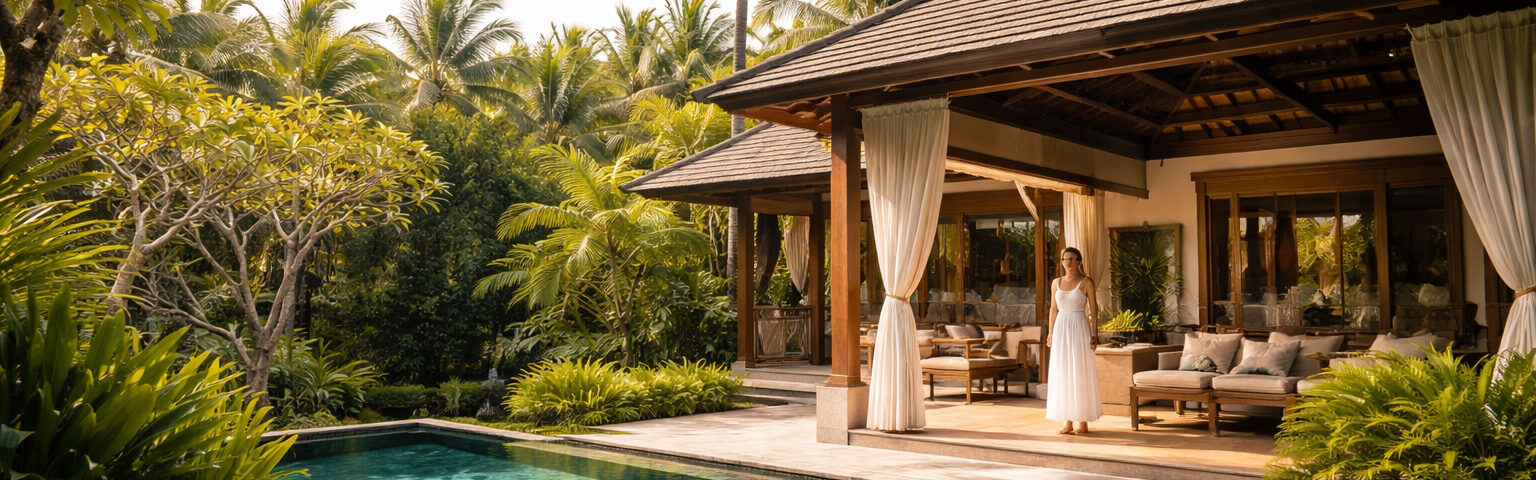
Bali’s strongest stays often manage this balance through design. Open-air living spaces keep a property connected to climate and garden life, while walls, planting, and room positioning preserve privacy. Natural materials such as timber, stone, and woven textures help accommodation feel rooted in place, while soft boundaries between indoors and outdoors prevent the stay from feeling closed off.
This relationship between place, design, and mood is one of the most compelling parts of the island’s built environment. For a wider architectural perspective, ArchDaily’s coverage of tropical architecture provides useful examples of how openness and shelter can work together in warm-climate spaces.
Calm Feels Better When It Is Chosen
Another reason this balance matters is psychological. Calm is often more satisfying when it feels chosen rather than imposed. A stay that offers privacy as an active relief from movement and noise tends to feel more rewarding than one that is merely quiet because it is cut off from everything. In the same way, connection feels better when it does not come at the expense of rest.
The best Bali escapes understand that travellers do not want one thing all the time. They want different things at different hours. A slow breakfast, a midday outing, an afternoon by the pool, dinner out, then a peaceful return. Stays that support those transitions feel more intuitive and more successful than those built around only one mood.
A Better Escape Feels Both Sheltered and Alive
In the end, the best Bali escapes are rarely the ones that choose between privacy and connection. They are the ones that hold both. They protect calm without becoming detached, and they stay connected to the island without allowing that connection to become overwhelming. That is often what gives a place its lasting appeal.
Bali rewards this balance because the island itself lives in balance — between ceremony and leisure, architecture and landscape, quiet and movement. The best stays reflect that truth. They do not just give travellers somewhere attractive to sleep. They give them a way to inhabit Bali that feels both peaceful and fully alive.