
Bali Stay Tips
How to Choose a Bali Stay That Still Feels Rooted in Place
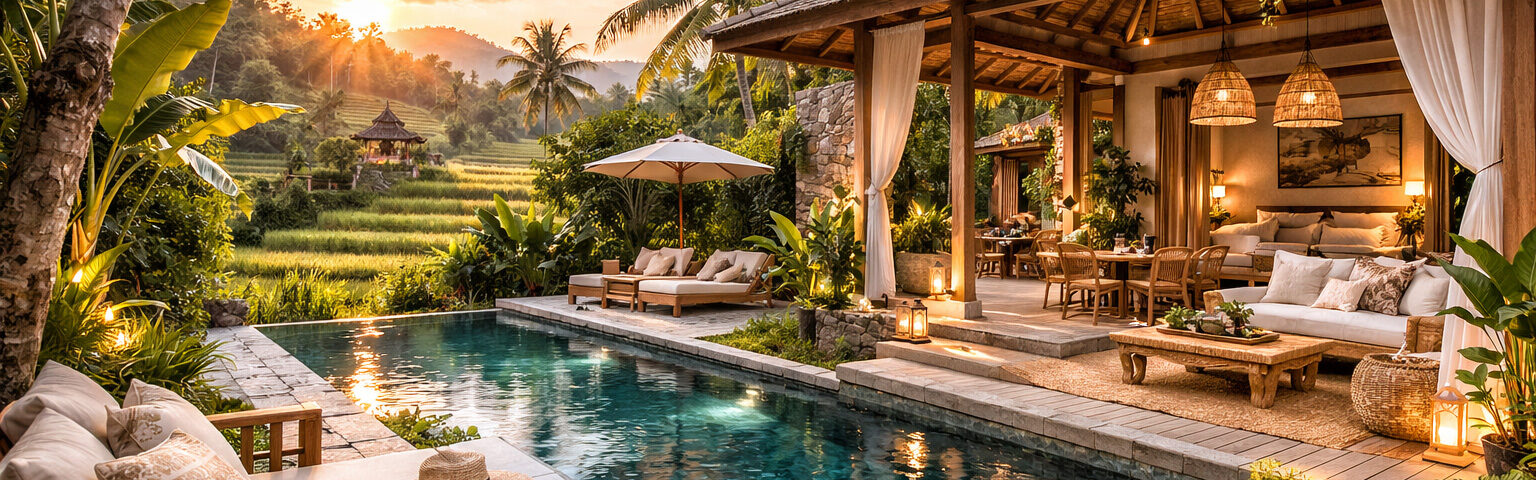
Not every stay in Bali feels equally connected to the island around it. Some properties could almost exist anywhere: polished, comfortable, attractive, but strangely detached from their setting. Others feel grounded from the moment you arrive. The light, the materials, the garden, the way the building opens to the air, and even the pace of the space all suggest that this stay belongs exactly where it is. For many travellers, that difference quietly defines the whole trip. It is the difference between accommodation that simply looks good and accommodation that feels part of Bali itself.
Bali has a strong identity as a destination, and that identity is not only scenic. It is architectural, cultural, and atmospheric. A broad overview of the island can be found in the Encyclopedia.com entry on Bali, but what travellers often respond to most strongly is how that broader identity is translated into the spaces where they stay. When a property feels rooted in place, the whole travel experience becomes more convincing.
Atmosphere Matters as Much as Amenity
It is easy to begin with the obvious things when choosing accommodation: a pool, generous bedrooms, outdoor seating, polished bathrooms, or attractive photography. Those things do matter. But on an island like Bali, atmosphere often matters just as much. A stay may have every comfort on paper and still feel oddly generic if the space does not reflect the environment around it.
What creates atmosphere is usually subtle. It may be the relationship between the building and the garden, the use of local textures, the softness of the light inside the rooms, or the way indoor and outdoor spaces are allowed to overlap. These things do not always dominate a listing, but they are often what travellers remember afterward.
Look for a Sense of Relationship With the Landscape
One of the clearest signs that a Bali stay feels rooted in place is how it responds to the landscape. A strong property rarely feels dropped onto the site as an isolated object. Instead, it seems to work with planting, light, paths, courtyards, and views. Even where the footprint is modest, the stay should still feel as though it has a relationship with the land around it.
This is one reason gardens matter so much in Bali stays. They do more than decorate the exterior. They soften boundaries, shape privacy, filter sunlight, and create transitions between spaces. A property that uses planting thoughtfully often feels calmer and more connected than one that relies only on polished surfaces and furniture.
Openness Should Feel Natural, Not Forced
Bali is often associated with open-air living, but openness works best when it feels natural rather than theatrical. Some stays are designed to showcase openness as a visual gesture, yet they do not necessarily make everyday use of the space easy. Others feel more intuitive. You can move from terrace to living area, from bedroom to garden edge, or from shaded seating to the pool without that movement ever feeling staged.
This kind of openness tends to make a property feel more genuinely of its place. It reflects the climate, supports a slower rhythm, and lets travellers remain aware of air, light, sound, and greenery without sacrificing comfort. That balance is part of what makes the best Bali stays feel memorable.
Materials Help a Property Belong
Another thing to notice is material choice. Timber, stone, matte plaster, woven details, and natural fabrics usually feel more convincing in Bali than colder or more synthetic finishes. They connect the building to the island’s visual language and make interiors feel warmer and less transient.
Materials also shape how a property responds to changing daylight and weather. They absorb light softly, create texture without noise, and help rooms feel grounded rather than overly polished. Even simple design decisions can make a stay feel more authentic when the surfaces around you seem to belong to the setting.
Cultural Presence Can Be Quiet but Important
A stay does not need to announce local influence in an obvious way to feel connected to Bali. In fact, the strongest properties often handle this more quietly. It may appear in spatial layout, in carved details, in thresholds, shrines, courtyards, or in the general sense that the property respects its surroundings rather than trying to dominate them. Bali has long been associated with ideas of balance between people, nature, and the spiritual environment, and the broader concept of Tri Hita Karana gives useful cultural context for that way of thinking.
Even travellers who know nothing about architecture or local philosophy tend to feel the difference. A place with cultural presence usually feels more settled, more coherent, and less interchangeable. That coherence can quietly elevate the whole stay.
The Best Choice Often Feels the Least Generic
In practical terms, choosing a Bali stay that feels rooted in place means looking beyond the headline features and asking a different question: does this property feel like it belongs here? Does it seem shaped by climate, landscape, and atmosphere, or simply styled for online appeal? The more a stay reflects its setting, the more likely it is to feel meaningful rather than merely convenient.
Ultimately, that is one of the pleasures of travelling in Bali. The island offers not only beautiful places to stay, but the possibility of staying somewhere that deepens the whole experience of being there. When a property feels rooted in place, accommodation becomes more than background. It becomes part of the journey itself.