
Bali Stay Tips
Why Some Bali Stays Feel Instantly Calmer Than Others
Not every Bali stay creates the same feeling on arrival. Some places seem to relax you almost immediately. The pace slows, the noise of travel fades, and the space around you feels easy to settle into. Others may look attractive in photographs but feel strangely restless once you are actually there. The difference is rarely down to one dramatic feature alone. More often, it comes from a combination of small decisions — layout, privacy, light, airflow, sound, and how the property relates to its setting.
This is one of the reasons Bali can be so rewarding when accommodation is chosen well. The island has a strong design language and an atmosphere that naturally lends itself to slower, more restorative stays. But not every property captures that equally. Some spaces make calm feel effortless, while others remain busy in subtler ways. For a broad sense of how place, environment, and everyday life connect in Bali, UNESCO’s overview of the Cultural Landscape of Bali Province gives useful background.
Calm Often Begins With Arrival
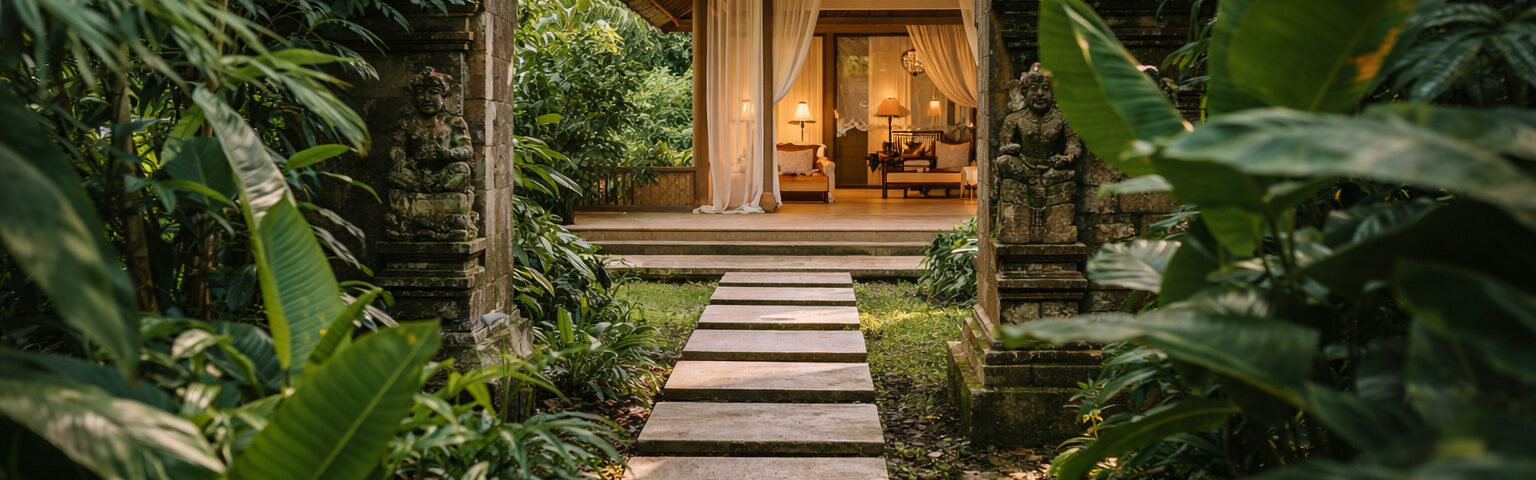
The first few minutes inside a property matter more than many travellers realise. If arrival feels abrupt, noisy, or visually cluttered, that sensation can linger. By contrast, a stay that opens gradually — through a gate, a planted path, a courtyard, or even a simple transition from road to terrace — tends to feel more composed from the start. Calm is often established before a guest even reaches the main living area.
In Bali, that transition can be especially important because the surrounding environment is so active. Roads can be busy, scooters constant, and public spaces energetic. A strong stay does not need to be remote, but it should offer a genuine sense of crossing into another rhythm. The best properties manage that shift almost invisibly.
Light Shapes the Mood of a Space
Light has a stronger emotional effect than people often admit. Harsh interiors, dark corners, or badly balanced rooms can make even a stylish property feel less restful than expected. In Bali, where soft daylight is part of the experience, the most calming stays are usually the ones that work with natural light rather than against it.
This does not necessarily mean brightness everywhere. Calm often comes from contrast: shaded spaces beside open ones, filtered daylight through planting or curtains, and rooms that feel soft rather than glaring. When light is handled well, the whole stay feels more breathable. It encourages slower movement, quieter mornings, and a stronger sense of ease.
Sound Can Make or Break a Stay
One of the least visible parts of accommodation design is sound. Yet it has a huge influence on whether a stay actually feels peaceful. A property may look private, but if traffic, neighbouring activity, or echoing internal spaces dominate the experience, calm can quickly disappear. By contrast, places that soften sound — through planting, thoughtful layout, enclosed courtyards, or better room positioning — often feel immediately more restorative.
Bali’s climate and architecture can either amplify or reduce this effect. Open-air living is beautiful, but it works best when balanced with enough shelter and structure to stop a property from feeling acoustically exposed. A calm stay is not necessarily silent; it simply carries the right sounds in the right proportion.
Privacy Is More Than Seclusion
Travellers often talk about privacy as though it only means distance from other people, but in practice it is more nuanced than that. Privacy can come from how a space is screened, how views are framed, where bedrooms sit in relation to communal areas, or whether outdoor zones feel protected without becoming enclosed. A stay can be close to lively districts and still feel calm if it is designed to hold its own atmosphere.
This is one reason planting is so important in Bali. Gardens, walls softened by greenery, and layered tropical foliage can all create a stronger sense of retreat. They change what you see and how you move, making the stay feel less exposed and more self-contained.
Good Layout Reduces Friction
Calm also comes from how easily a property works. Awkward circulation, cramped transitions, poor seating placement, or disconnected spaces can subtly create irritation throughout the day. A more thoughtful layout does the opposite. It allows people to move naturally between sleeping, relaxing, dining, and spending time outdoors without feeling that each activity requires adjustment or effort.
This is why some stays feel immediately more natural. There is less friction in the environment. You do not have to think about how to use the space; it simply supports you. That kind of ease is one of the least flashy but most valuable forms of design quality.
Material and Texture Affect Comfort
Calm is not only visual or spatial. It also comes from texture. Timber, stone, soft fabrics, matte surfaces, woven details, and natural tones all tend to soften the emotional temperature of a space. They create warmth without heaviness. In tropical accommodation especially, those materials often work better than overly glossy or sharply reflective finishes, which can feel colder and more transient.
For a broader view of how this works in tropical settings, ArchDaily’s coverage of tropical architecture offers useful design examples and context. The details vary, but the principle remains consistent: materials that feel grounded often support more grounded stays.
Calm Is Usually Designed, Not Accidental
The most peaceful Bali stays are rarely calm by chance. They feel that way because the space has been shaped to support slower living. Arrival is softened, sound is considered, light is balanced, privacy is protected, and the layout encourages ease rather than interruption. None of these qualities is especially showy, but together they create the feeling many travellers are actually looking for.
In that sense, calm is one of the most underrated luxuries in Bali. It does not always photograph dramatically, but it often defines whether a stay becomes memorable. A beautiful property may catch attention at first glance. A calm one is the place people still think about after they leave.